Anime Dubbing Explained: From Studio Booth to Screen
Summary
Anime dubbing combines translation, voice performance, and tight lip-sync timing into a precise craft. Studios now deliver dubbed episodes within days of the Japanese broadcast. AI tools like ElevenLabs and HeyGen handle the voice and lip-sync layers for creators who want to port their own videos into another language without a full studio operation.
Anime dubbing is one of the most visible forms of video localization, and also one of the most argued-about. Strip away the fan debate, though, and what remains is a craft problem: how do you take a performance recorded in one language, timed to animated lip movements, and rebuild it in another without losing the emotion or breaking the illusion?
That question turns out to be as relevant for a YouTube creator dubbing a tutorial into Spanish as it is for Funimation adapting a 24-episode shonen series into English.
What Actually Happens in an Anime Dubbing Session
The process starts well before anyone steps into a recording booth. A script translator works from the original Japanese, but the goal is not a literal rendering. Every line has to fit inside the animated character's mouth movement window, match the scene's emotional weight, and read naturally when spoken aloud in the target language.
That last part is harder than it sounds. Japanese and English have different syllable structures and cadences. A line that takes three seconds to deliver in Japanese might run to four in English if the translator stays too close to the source. Dubbing directors call this process mouth fitting: finding an adaptation that lands in the right rhythm without sounding clipped or padded.
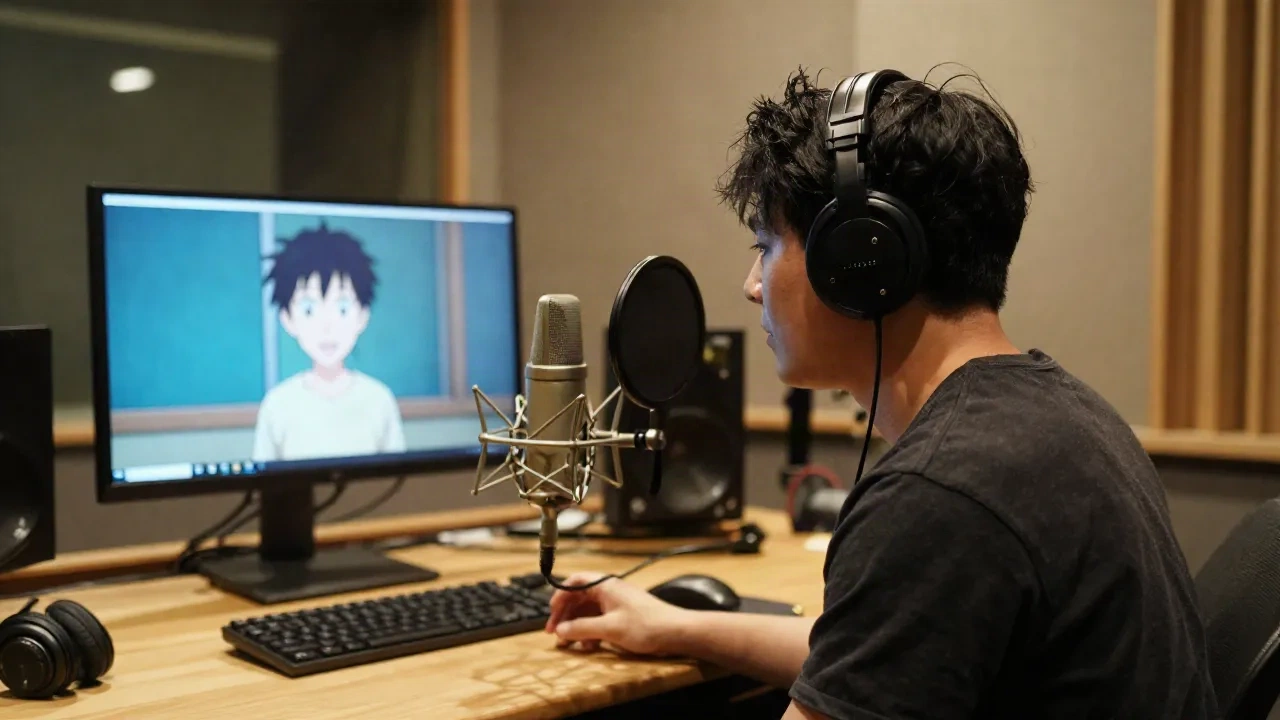
Once a script is locked, voice actors record to picture. They watch the animation on a monitor while reading their lines, hitting the mouth openings as closely as possible. Retakes are common. The director may ask for more intensity, a different character read, or a tighter fit on a specific syllable. The recorded tracks then go to a mix engineer who layers them against the original music and sound effects before the finished dub is delivered.
The whole chain, for a single episode, can take two to four weeks from script to delivery. For a full cour of 12 to 13 episodes, that means months of parallel work.
Why the Dub vs Sub Debate Still Runs in 2026
The argument has been alive since the late 1990s, when VHS fansubs made imported anime accessible outside Japan and a generation of Western fans formed strong opinions early. The purist position is that subtitles preserve the original performance, including tonal textures that no translation can fully carry. The dub position is that if the adaptation is good, you can watch the animation rather than split your attention between image and text.
Recent data has shifted the frame. Crunchyroll's 2025 global viewership report showed dubbed content outpacing subtitled content as the preferred format in every tracked country outside Japan. Netflix's anime slate from 2024 onward has been routinely dubbed into a dozen or more languages from day one. The operational assumption at major streaming platforms is that a significant share of the audience will not read subtitles.
That does not settle the debate on quality. A poorly cast or loosely adapted dub is a harder watch than a clean subtitle. What the data does settle is the audience question: dubs are not a compromise format for casual viewers anymore. They are the primary format for a large share of anime's global audience.
The Hardest Part of Dubbing Isn't Translation
Most listeners assume the translation is the central challenge. It is not. The central challenge is timing.
A subtitle can sit under the frame for as long as it takes the viewer to read it. A dubbed line has to end when the character's mouth closes. That constraint turns every sentence into a timing puzzle. A good dubbing writer is part translator, part rhythm editor.
The standard measure in subtitle work is characters per second, or cps: the number of characters that can reasonably be read in a given display window. Subtitle guidelines for broadcast sit at around 17 cps for adult audiences. Faster, and the viewer is racing the text rather than watching the scene. Dubbed lines face an equivalent but inverted constraint: they cannot run long, but they also cannot leave an unnatural silence where the character's mouth was moving.
Anime adds a specific wrinkle. Because the original animation was lip-synced to Japanese, the mouth movements are designed around Japanese phoneme patterns, which cluster differently than English. A wide-open mouth in Japanese is often on a vowel that English might replace with a consonant cluster. Dubbing directors develop a vocabulary of substitution lines: words and phrases that land on the right phoneme shapes without sounding forced.
The framing at SubsVideo applies here: a subtitle is a reading experience, and a dub is a listening one. Both are interpretations of the original, and both require the same underlying decision - when to let the language breathe and when to cut.
Simuldub Closed the Release Gap
For years, the practical argument against English dubs was release lag. A new anime would drop in Japan, fan-subtitled episodes would appear online within hours, and the official English dub might land six months to a year later. By then the fan community had already processed every story beat, and watching the dub meant already knowing what happened.
Funimation and later Crunchyroll invested in a simuldub pipeline that runs dubbing in parallel with the original Japanese production. Voice actors record to a rough animatic before the animation is finalized, using director notes to match the intended performance. The finished episode then releases within days of the Japanese broadcast.
That shift changed the competitive calculus for dubs. A creator following a seasonal anime no longer has to wait to watch in their preferred format. The growth in dub viewership since 2022 suggests the audience noticed.
Simuldub is not free. It requires standing contracts with voice talent, a stable of adapters who can turn around a script quickly, and recording infrastructure that can handle overlapping deadlines. Those are studio resources. Most independent creators working in video localization do not have them.
Can AI Tools Replicate What Studios Do?
Not completely, but they address specific pieces of the process well.
The dubbing chain has four bottlenecks: translation, voice performance, lip synchronization, and mix engineering. AI tools in 2026 address the first three with varying degrees of reliability.
On translation, machine translation handles everyday declarative sentences well. It struggles with idiomatic lines, character register, and the phoneme-fitting constraints a human adapter applies by instinct. Translation is still the step where human review pays off most.
On voice performance, tools like ElevenLabs can clone a voice from a short sample and re-voice a translated script with preserved speaker character. The result is not a directed performance in the studio sense, but the speaker identity holds across a full piece. For creators dubbing a long-form tutorial or a course where the presenter's voice matters, that consistency is genuinely useful.
On lip synchronization, newer platforms layer video processing onto the dubbed audio to reanimate mouth movement to match the new language. The result is not frame-perfect, but at typical web resolution and playback speed the discontinuities are rarely distracting.
What no AI tool does well yet is the directing layer: the decision to re-read a line because the actor didn't land the vulnerability the scene needs, or to swap a word because the previous choice reads as stiff when spoken aloud. That judgment is still human.
What Dubbing Teaches Creators About Voice Timing
Professional anime dubbing is a closed-loop quality system. Every line is reviewed against picture. Every performance is re-read until the timing works. That discipline is excessive for most creator contexts, but the underlying habits transfer.
A creator who has studied a few behind-the-scenes dubbing sessions comes away with a different relationship to their own voice-over timing. They notice where a line rushes past a visual beat it should let breathe. They hear the syllable a word adds to a sentence that didn't need it. They think about line length before they record, not after.
For a creator building a subtitle or dubbing workflow, the equivalent question is simpler. Does the timing of this audio match the timing of what the audience is seeing?
Where to Start if You Want to Dub Your Own Video
Most creators who want to carry their video content to another language face a choice between three approaches.
The first is subtitles only. Machine translation handles the first pass; a native-speaking reviewer corrects register and phrasing; the subtitle file is timed to match the existing audio. Cost is low. Result is a watchable video for audiences who read the target language. Quality ceiling depends on the reviewer.
The second is AI dubbing, where a tool translates and re-voices the video automatically. Turnaround is hours rather than days. Quality is usable for tutorials, product demos, and explainers where the priority is information delivery rather than emotional performance. Lip-sync re-animation works better on talking-head footage than on footage with significant camera movement or multiple speakers.
The third is human voice casting, the closest analogue to how studios work. A translator adapts the script with timing constraints in mind; a voice actor records to picture; an editor syncs the new track. This is the highest-quality option and the most expensive. It makes sense for content that will receive significant distribution, where the presenter's voice is part of the value.
Most creators will start at option one or two. The real question is what your audience needs from the video. If they are watching to learn a procedure, accurate subtitles or a clear AI dub are enough. If they are watching because they trust the presenter's judgment, a voice that sounds nothing like the original can break that relationship.
Anime dubbing studios learned that lesson decades ago. Casting is one of the steps they have never handed to a machine. That is worth keeping in mind before you hand it to one either.